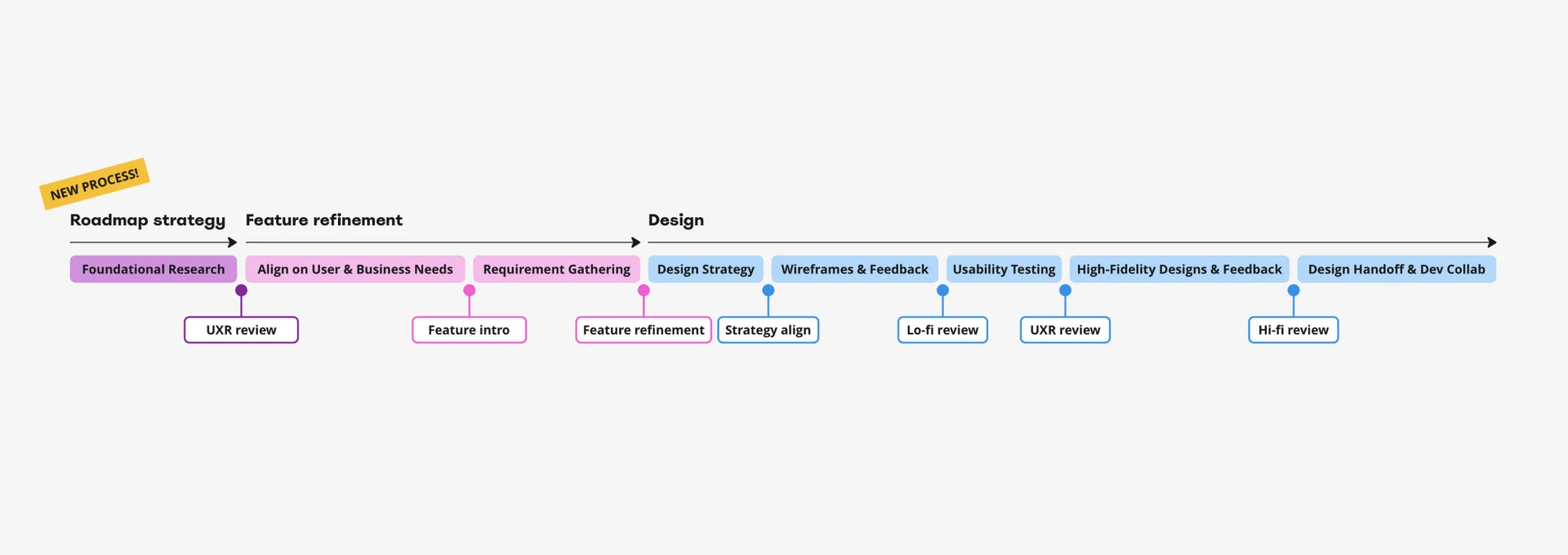
Interviewing both Product and Design to find the real friction points, then co-creating a new working agreement that cut delivery time by 35% and won a CVS Excellence Award.
CVS's design org shifted from a "consulting" model where Design and Product worked separately, to an "embedded" model where designers joined individual Product teams. It was the right direction — but there was very little guidance on how to actually collaborate in this new structure.
Pain points surfaced quickly: ambiguous feature requirements because Design wasn't included in planning, repeated feedback loops because Product only saw work late in the process, and growing frustration on both sides even though the relationships were genuinely strong. We figured that if we could get aligned with our Product partners on what was actually going wrong, we could fix it together.
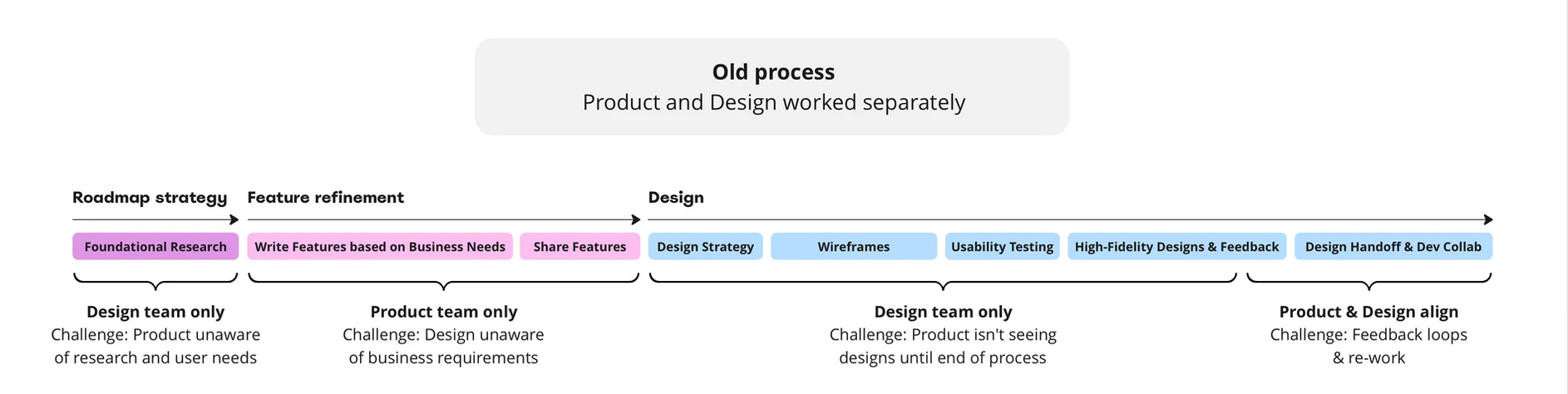
Old process: Design and Product working in separate lanes, causing late-stage feedback and misaligned expectations.
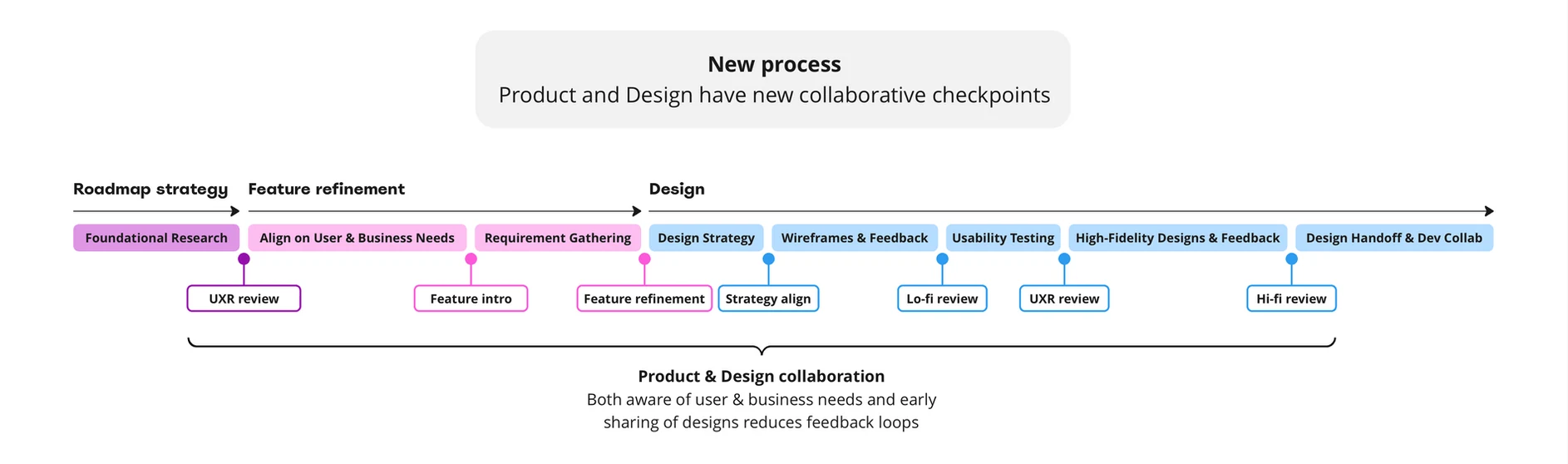
New process: collaborative checkpoints throughout, getting Product involved early and Design informed from the start.
Jordan and I set up a meeting with our Design Director (Ethan) and Product Director (Aviel) to align on what we were trying to fix. We agreed on three goals: identify the pain points everyone was experiencing in the new model, understand what an ideal collaboration process looked like from both sides, and put together a working agreement that would clarify a new process with clear roles and responsibilities.
Our strategy for getting there had five steps: 1:1 interviews with each Product team member to understand their perspective, a design team "listening" workshop to hear from our designers, analysis of the feedback from both groups, a set of recommendations for each step in the process, and finally a working agreement created together with the full team.
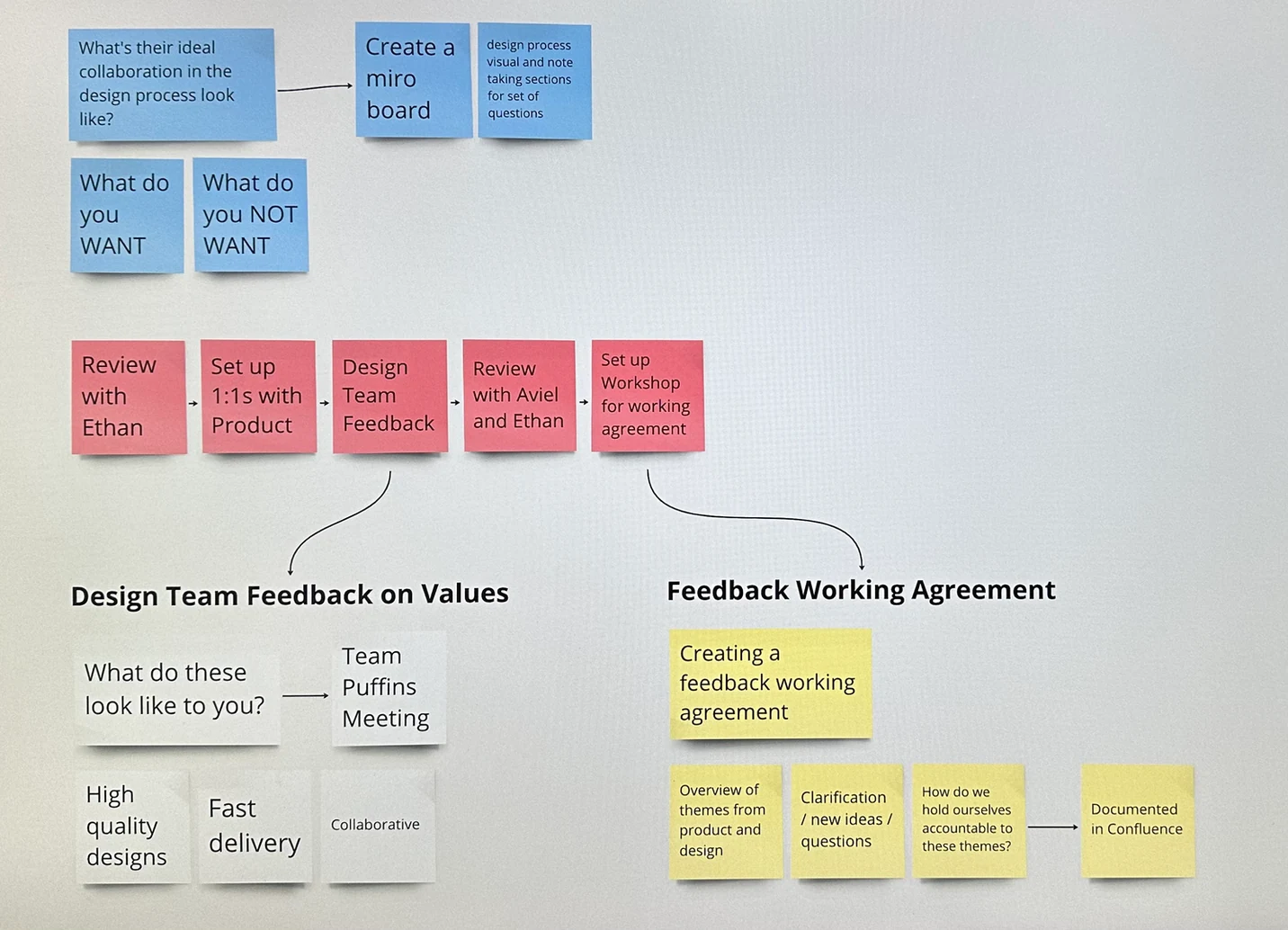
Our strategy for understanding both sides and arriving at a shared working agreement.
Jordan and I conducted 1:1 interviews with seven Product team members and facilitated a listening workshop with the full design team. Four questions guided every conversation: How do you define "high-quality design"? Efficient timing? Being "involved" in the process? And what does the ideal collaboration look like to you?
We traded off interviewer and notetaker roles in every session. The design team workshop was specifically framed as a "listening" session — a signal that this was about hearing concerns openly, not defending the current state.
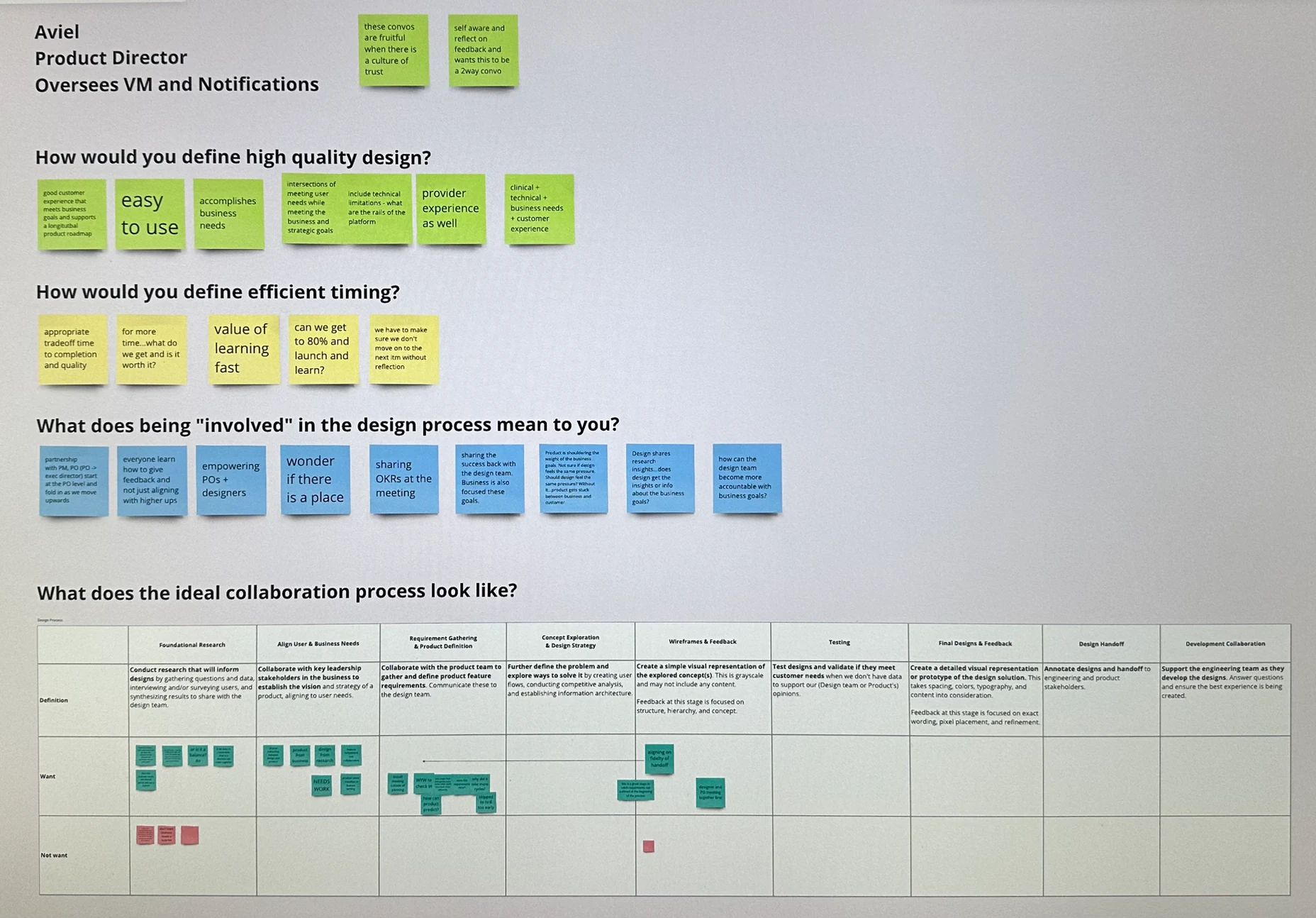
Notes from our Product Director interview — capturing their definition of quality, timing, and ideal collaboration.
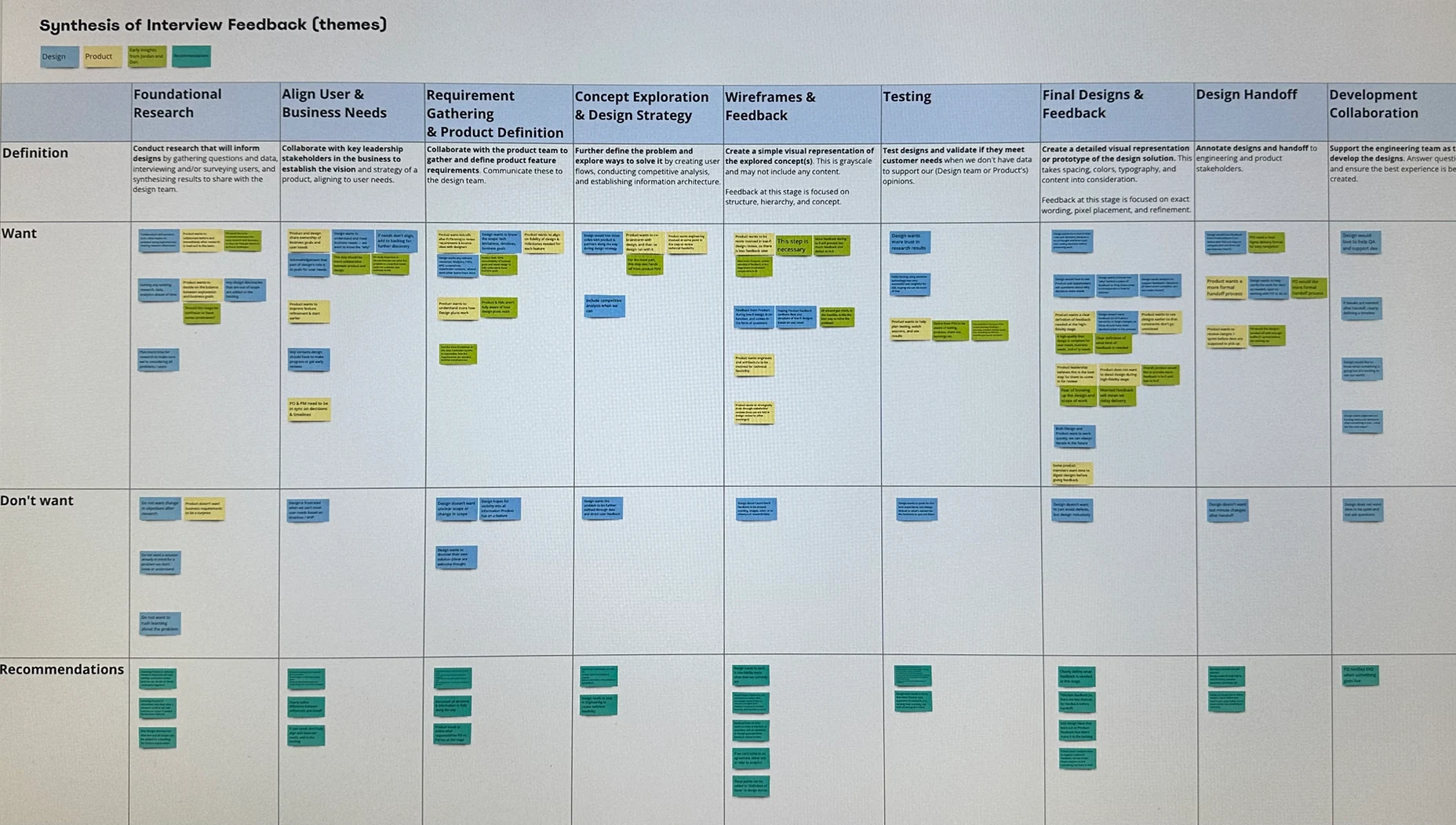
Affinity mapping synthesis — grouping themes from both sides to find patterns and common ground.
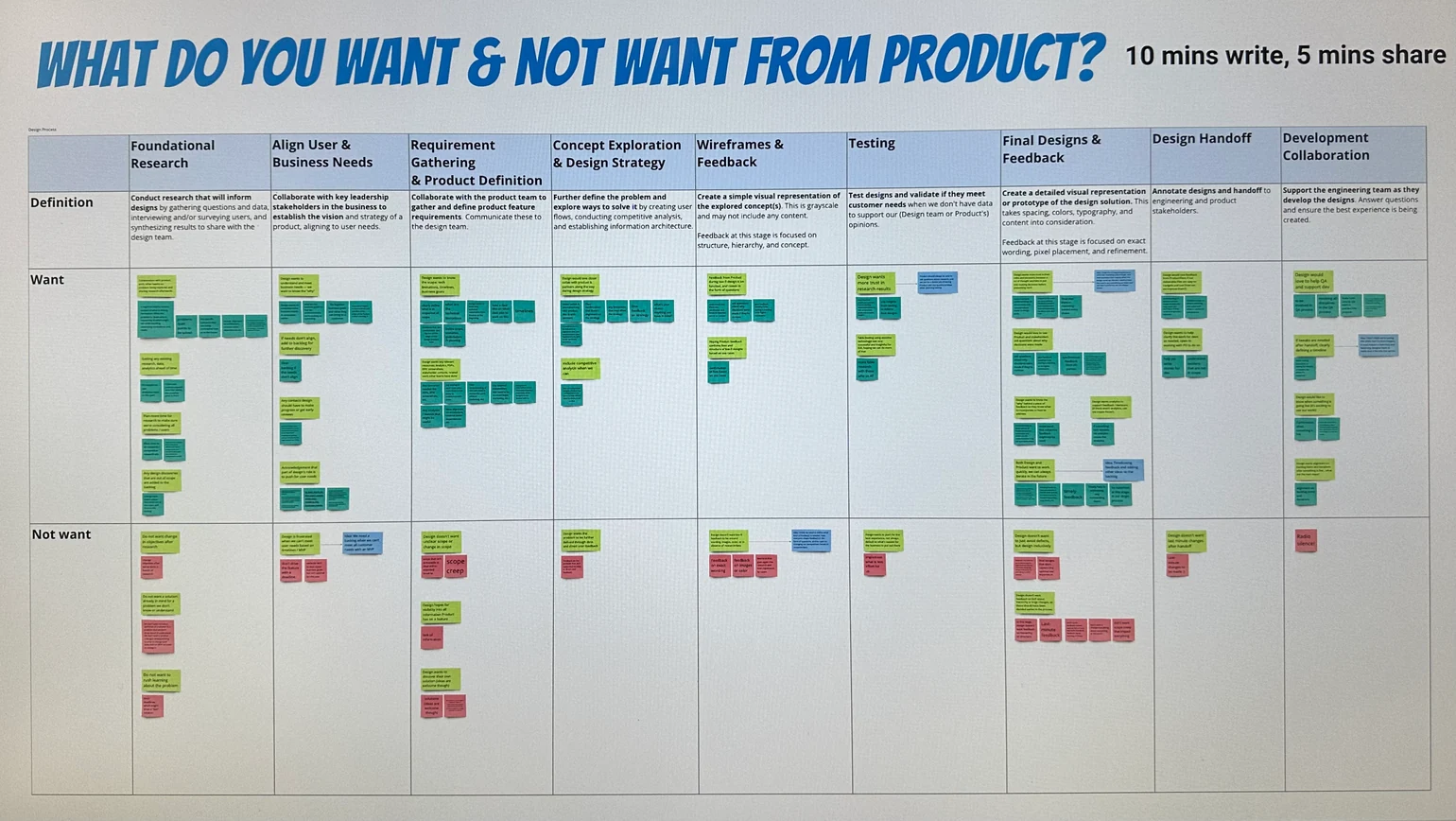
Design team listening workshop — what they wanted and didn't want from Product at each stage.
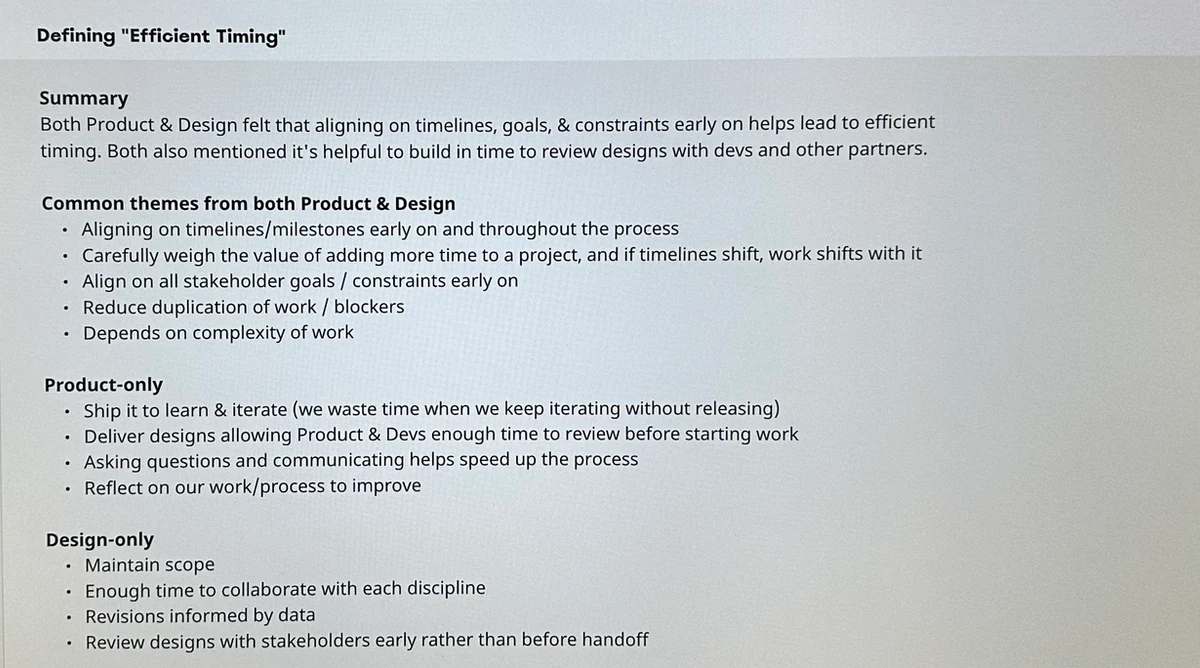
Synthesized themes on what "efficient timing" meant to both sides.
Based on our synthesis, Jordan and I proposed new checkpoints throughout the design process — bringing Product in earlier and more consistently, rather than only at the end:
We presented these recommendations to Design and Product leadership, refined based on their feedback, then ran a workshop with the full team to co-create the roles and responsibilities for each checkpoint. The final working agreement was published in Confluence and became our new standard.
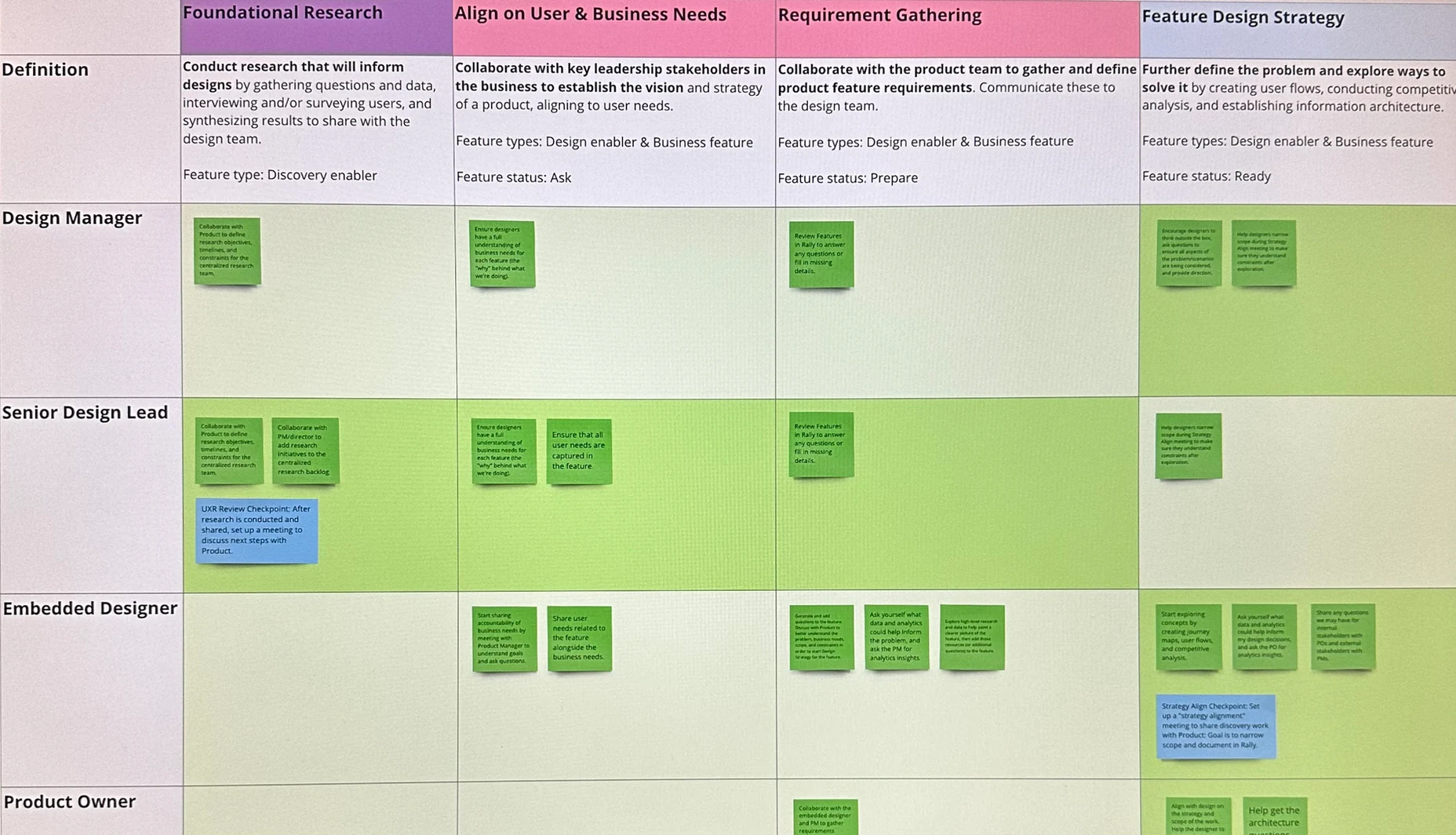
The finalized process — clear checkpoints, clear ownership, and no more late-stage surprises.
When designing a new "Sports physical" health form for students, our new "Strategy align" checkpoint let us share early design thinking with Product. Product then brought this thinking directly into Legal review — which meant we got Legal approval on design concepts much earlier than usual, saving the whole team significant time.
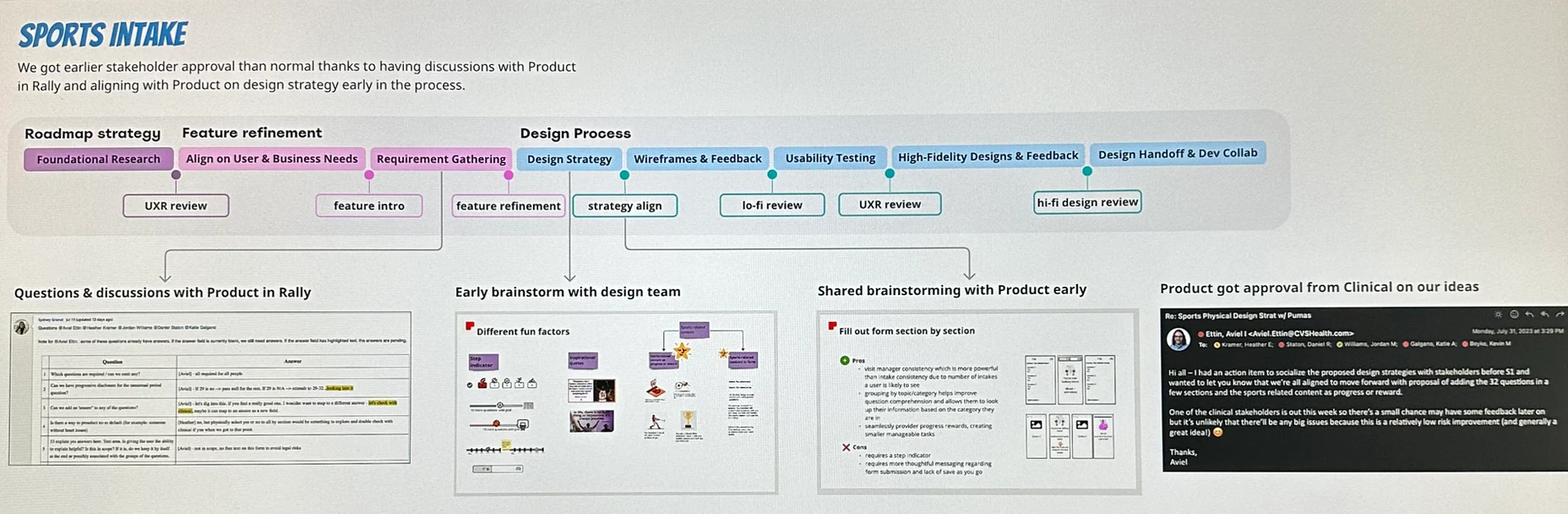
Sports Intake: our Strategy Align checkpoint led to faster Legal approval and a smoother process overall.
Our new "Lo-fi review" checkpoint let Product see early options and give feedback before we invested in high-fidelity work. For the Sports Notice of Self-Pay, we walked through multiple options for parent/guardian consent at the wireframe stage — and didn't have to go back and do costly rework later.
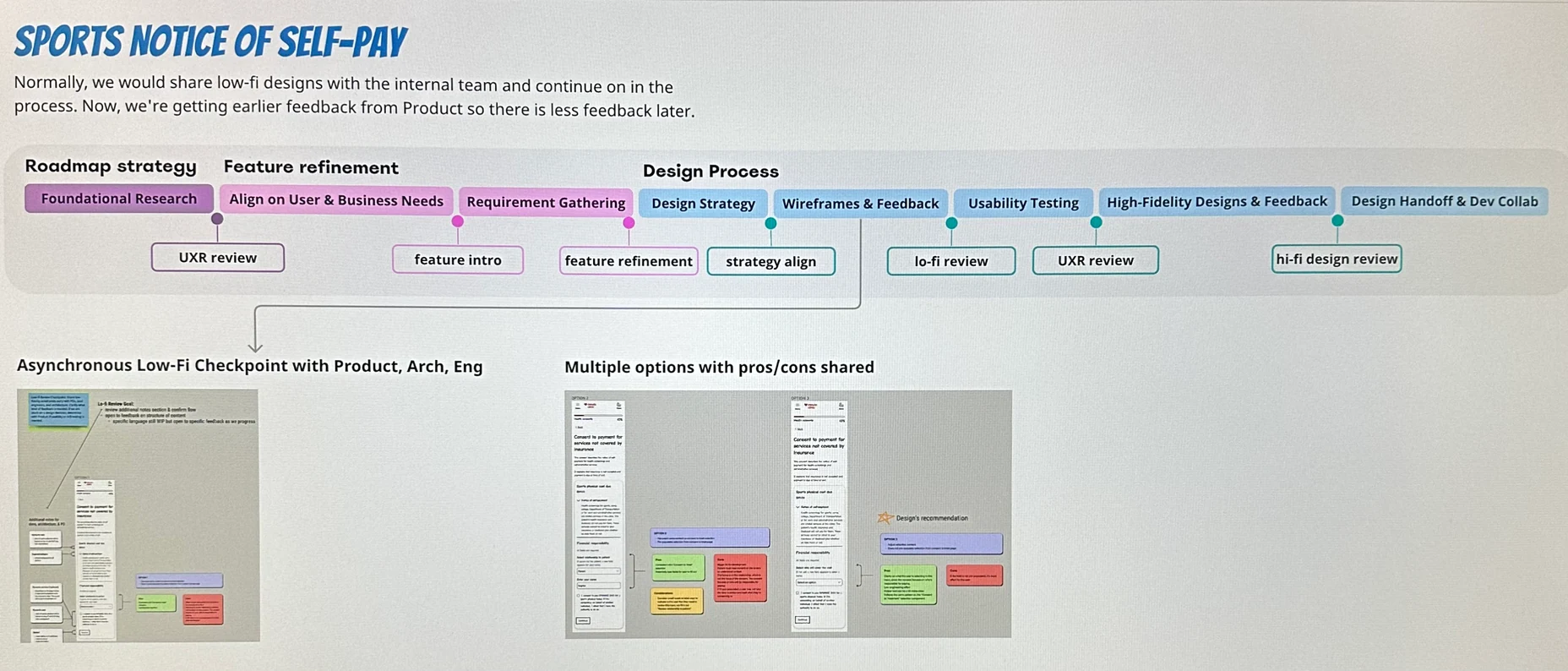
Sports Notice of Self-Pay: Lo-fi review eliminated the rework that would have happened later.
Sharing research during our new "UXR review" checkpoint gave Product the context of real user pain points that they otherwise wouldn't have seen until much later. This opened the door to much deeper explorations of how we could simplify the patient check-in experience.
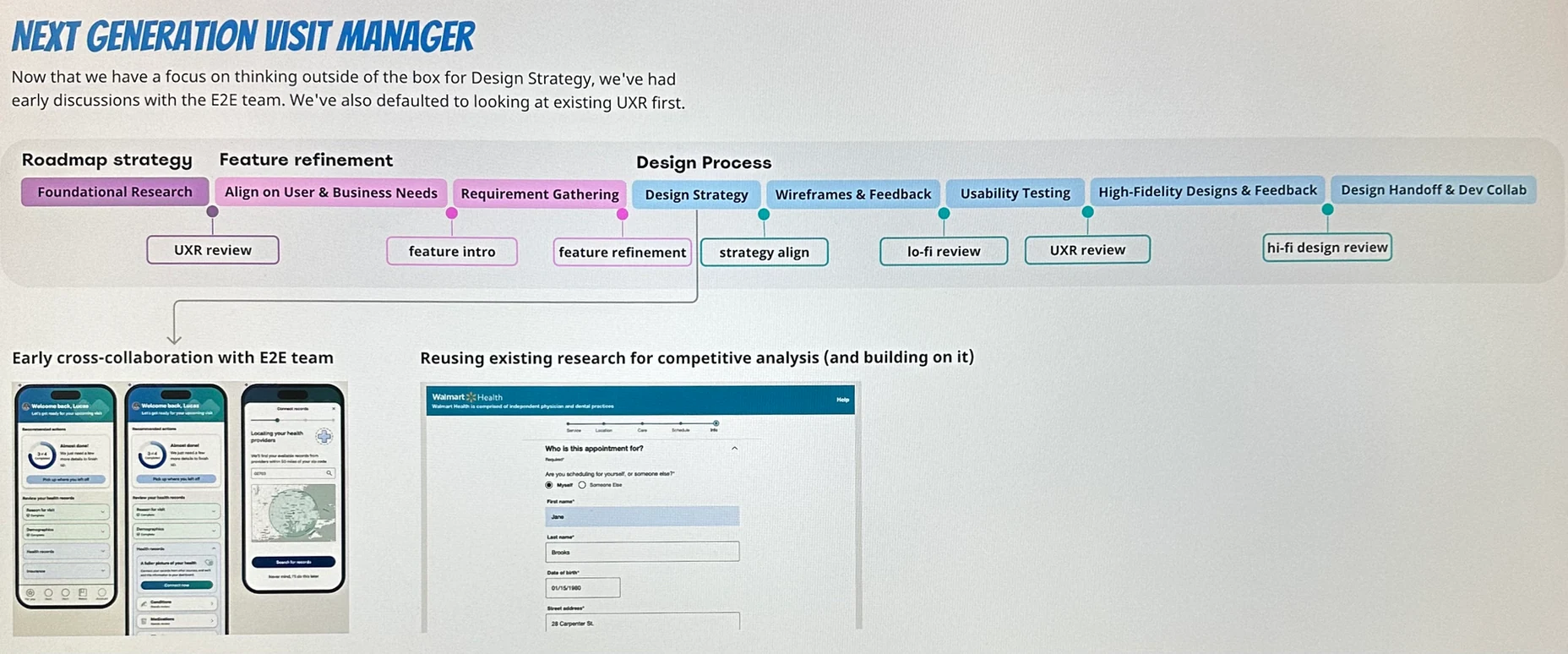
Next Gen Visit Manager: UXR review gave Product the context to think bigger about the check-in experience.
When an urgent feature needed to be completed in one sprint, our "Feature Intro" and "Strategy Align" checkpoints ensured Design understood the "why" behind the business request from day one. This made our communication smoother and our designs more on-target from the very beginning.
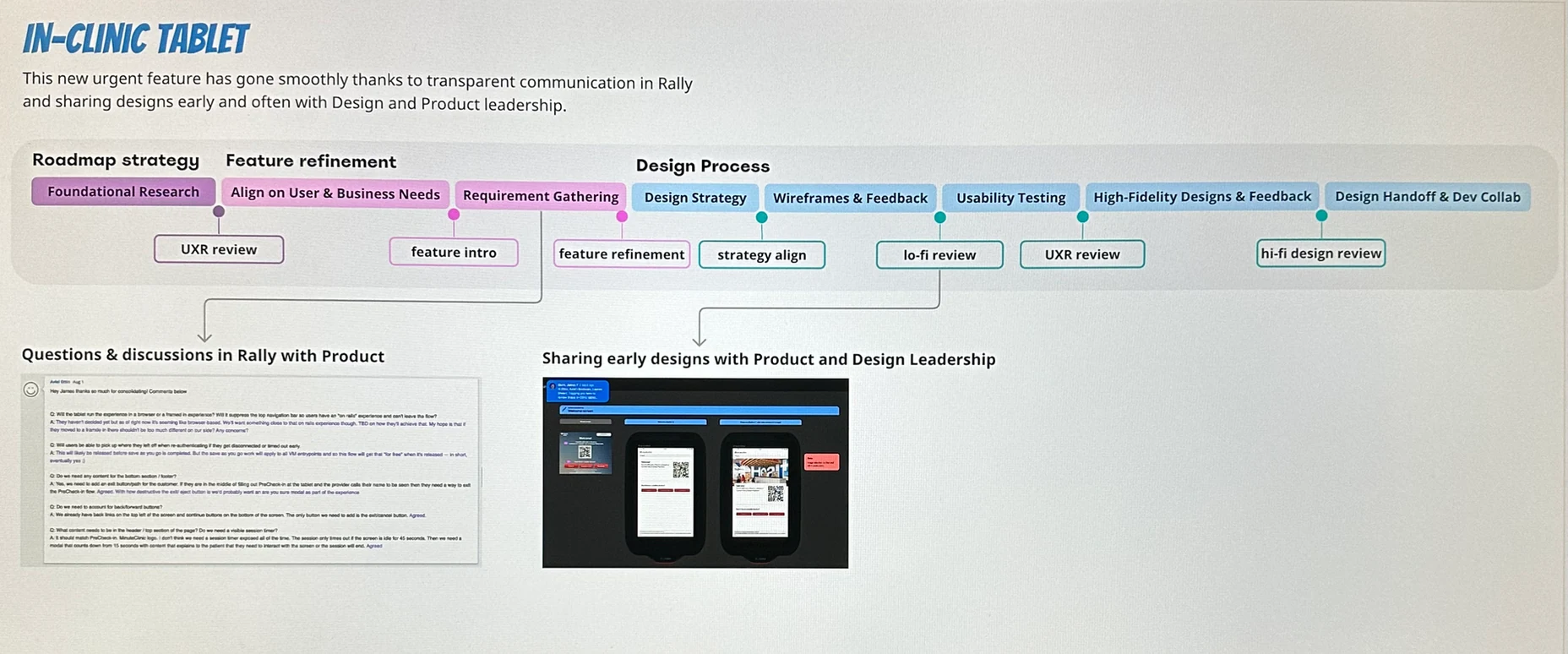
In-Clinic Tablet: new checkpoints made a one-sprint turnaround feel smooth instead of chaotic.
In the old process, updating a single line of content might have required multiple Rally stories and multiple rounds of reviews. With our new "Feature intro" checkpoint, Jordan set up a 30-minute brainstorm, and we made the decision with Product in a Teams chat within an hour. The new process freed us to move at the speed the work actually required.
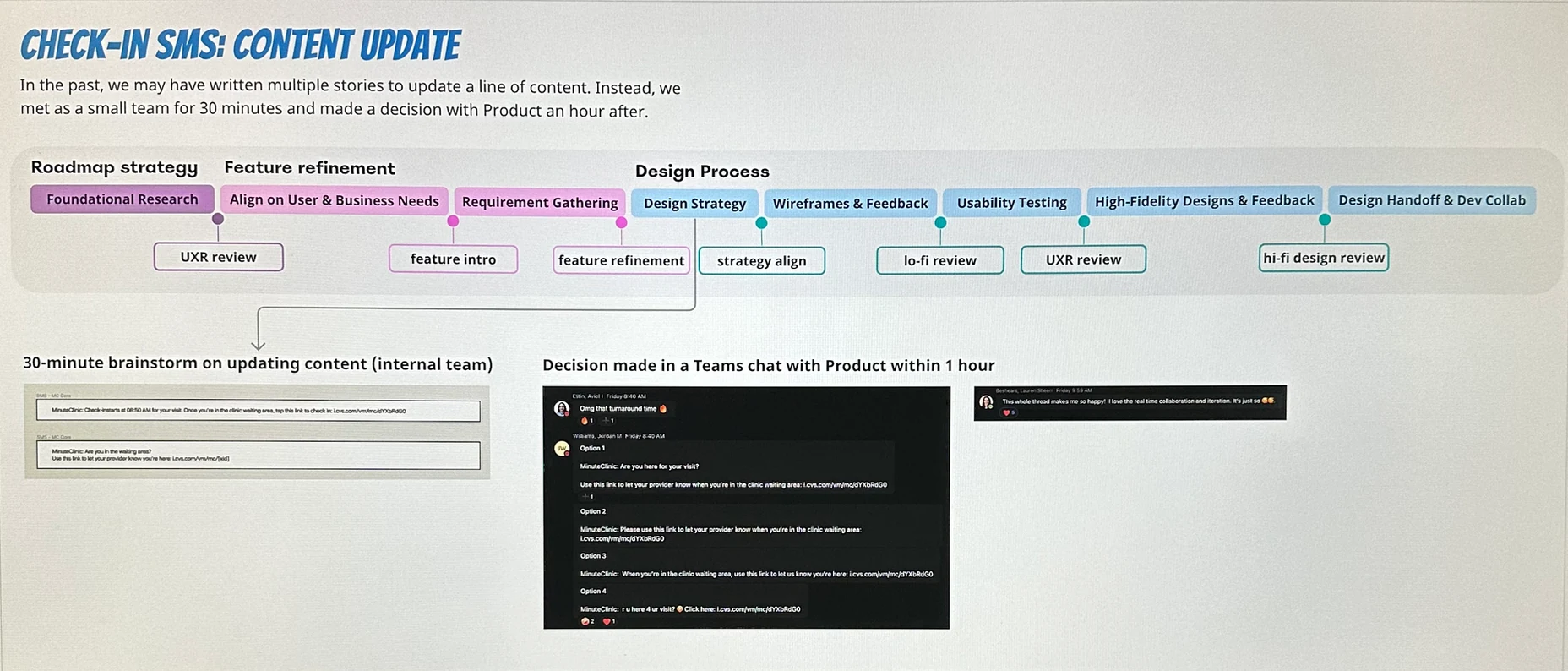
Check-in SMS: a content decision that would have taken days in the old process took 30 minutes in the new one.
Both Design and Product noticed the difference immediately. Here's what Product leadership shared with us directly: